PDCIS arrives in Angola to strengthen women farmers
The Brazilian experience that has been transforming rural communities in the Lower South of Bahia for more than two decades […]
13 de May de 2026
The Brazilian experience that has been transforming rural communities in the Lower South of Bahia for more than two decades […]
13 de May de 2026
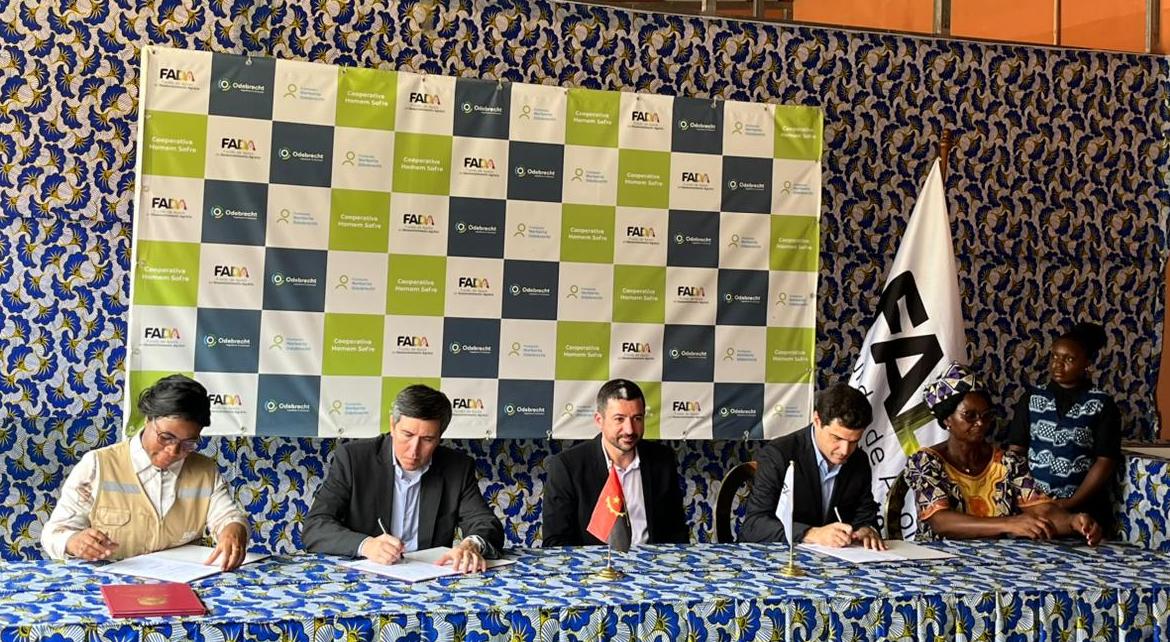
The Brazilian experience that has been transforming rural communities in the Lower South of Bahia for more than two decades is now reaching Africa. On May 12, the first international replication of PDCIS—the Integrated Development and Growth with Sustainability Program—was formalized. The program is coordinated by the Norberto Odebrecht Foundation and has already benefited over 700,000 people in Brazil.
Led by Odebrecht Engenharia in Angola, which invited the Foundation to implement the initiative in partnership with the Agrarian Development Support Fund (FADA) and Embrapa Cassava and Fruits—a strategic partner for technology transfer—the project, titled “Producing to Transform Lives,” will focus on strengthening family farming and creating opportunities for rural communities in Angola. The launch event took place after more than a year of exchanges and missions between the two countries and included the presence of local authorities, institutional representatives, farmers, and community members.
“The internationalization of our program is a milestone that consolidates years of structuring and strengthening the initiative, proven by impactful results,” says Norberto Odebrecht Neto, Superintendent of the Foundation. “Being able to replicate solutions that generate long-term development together with Odebrecht aligns directly with our work and with the Angolan government’s goals of eradicating poverty and ensuring food security.”
The work will be carried out with the Homem Sofre Cooperative, located in the Malembo territory, entirely composed of women farmers in a community where family farming is the main source of livelihood and income. The name “Homem Sofre” (Man Suffers) historically refers to the challenges of cultivation and the resilience required to work the land in the region—an identity the project now seeks to redefine by strengthening the cassava production chain, with women as protagonists.
To this end, the project focuses on technical training for cooperative members, improving family production systems, and strengthening the cooperative institutionally. Planned actions include technical assistance, training programs, support for crop diversification and commercialization, as well as the donation of inputs to address deficiencies identified through soil analysis. “We believe that this cooperation can significantly contribute to the sustainable growth of the cooperative and the Malembo community by promoting local agriculture, product processing, income generation, women’s empowerment, and the expansion of our products in local and national markets,” says Margarida Chilongo Carneiro, representative of Homem Sofre.
According to Gustavo Lima, Contract Director of the New Cabinda Airport (NAIC), a project executed by Odebrecht and linked to this initiative, the program reinforces the importance of bringing successful solutions to regions where the company has operated for more than 40 years, positioning it not only as a service provider but also as a reliable and socially responsible actor. “This partnership demonstrates our potential for joint construction in addressing the common challenges of rural development in the country,” he says. “This is possible when technical knowledge and community participation are combined.”
The project also includes actions aimed at strengthening the cooperative’s commercial organization and expanding market access, creating conditions to broaden its client base and improve product distribution. The focus is on building a solid foundation for income generation and food security across the Malembo region. This is reinforced by Felisbela Francisco, President of FADA’s Board of Directors, who highlights that “strengthening family farming requires not only technical training but also effective access to financing and tools capable of accelerating the economic growth of rural communities.”
About the Norberto Odebrecht Foundation
The Norberto Odebrecht Foundation (FNO) coordinates PDCIS, a sustainable territorial development program. Over 23 years, the initiative has impacted more than 700,000 people by promoting income generation and autonomy for rural families. Currently, the Foundation is expanding its social technology internationally through the program’s replication in Angola.
Do you wish to be
a partner in our projects, make
a donation or hire our technical consulting?
Send a message
right now!